Research File 003
Neuroscience &
The Brain
The most complex object in the known universe sits inside your skull. 86 billion neurons. 100 trillion connections. And we still don't know how it produces the experience of being you.
The most complex object in the known universe sits inside your skull. 86 billion neurons. 100 trillion connections. And we still don't know how it produces the experience of being you.

A neuron receives signals through its dendrites, processes them in the cell body (soma), and sends output down its axon to the next neuron. The gap between two neurons is the synapse — where chemical neurotransmitters (dopamine, serotonin, glutamate) carry signals across.
When a neuron receives enough input to cross a threshold, it fires an action potential — a sharp electrical spike travelling at up to 120 m/s. This all-or-nothing firing is what artificial neural networks loosely model — but the real thing is dramatically more complex.

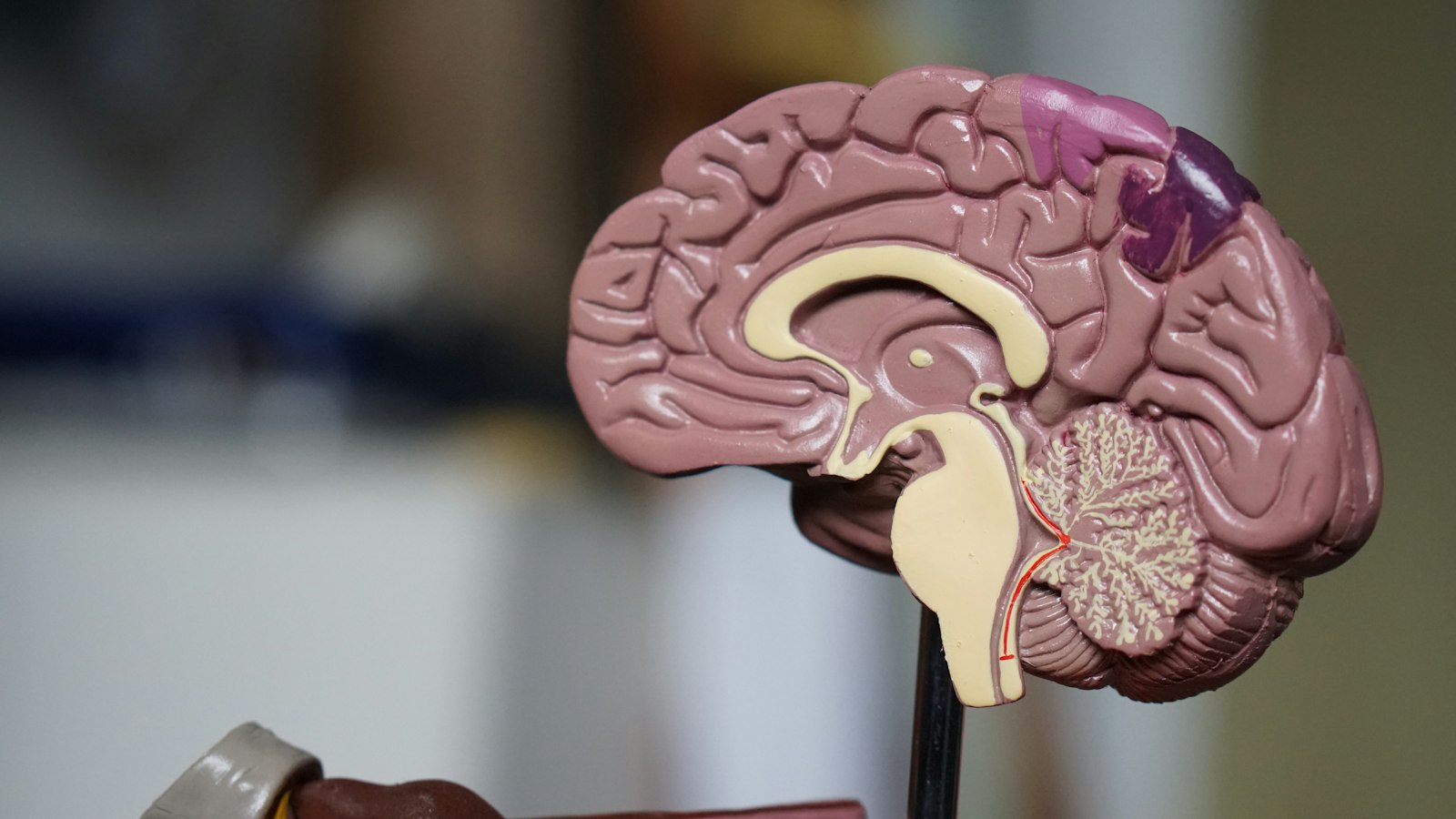
Planning, decision-making, impulse control, personality, abstract thought. Last region to fully develop — around age 25. Damage here can completely change who a person is — same body, different personality. This is what separates human cognition from other animals.
Memory formation and spatial navigation. New memories are consolidated here during sleep before being distributed to cortex for long-term storage. Destroyed first in Alzheimer's. Famous patient H.M. had both hippocampi removed — could never form new memories again, even recognised his doctors as strangers every day.
Fear, threat detection, emotional intensity. Reacts before the cortex does — why you jump before consciously registering the spider. Drives fight-or-flight. Heavily involved in anxiety, PTSD, and addiction. Two almond-shaped clusters, one in each hemisphere.
Motor control, balance, precise learned physical skills. Contains more neurons than the rest of the brain combined. Crucial for playing instruments, sports, anything requiring precise coordination. Damaged by alcohol — why drunk people can't walk straight.
30% of cortex is dedicated to processing vision. Arranged in hierarchical layers — each level extracts more complex features: edges → shapes → objects → faces. This exact architecture directly inspired convolutional neural networks (CNNs) in AI.
Broca's area: language production. Wernicke's area: language comprehension. Damage to each causes different, specific aphasias — proving language has distinct production and understanding mechanisms. Almost entirely left-hemisphere in right-handed people.
Every time you remember something, you are reconstructing it — pulling fragments from different parts of the brain and assembling a narrative. There is no playback button. Memories change every time you access them. They can be distorted, implanted, and lost.
This is why eyewitness testimony is unreliable. Why childhood memories feel vivid but contain factual errors. Why trauma memories are fragmented. Memory is active reconstruction, not passive storage.


We can explain how the brain processes vision, produces language, stores memories. What we cannot explain is why there is a subjective experience at all. Why does seeing red feel like something? Why is there an "inside view" — a what-it's-like to be you — rather than information processing happening in the dark?
Consciousness arises when information is "broadcast" to a global workspace accessible to many brain regions simultaneously. What's in the spotlight of attention becomes conscious. The most experimentally supported current theory.
Consciousness = the amount of integrated information a system generates (phi, φ). Higher phi = more conscious. Controversial prediction: some simple systems might be slightly conscious. Some very complex systems (like the internet) might not be, because info isn't sufficiently integrated.
The brain is a prediction machine — constantly generating predictions about sensory input and only updating when surprised. Consciousness may be the brain's model of itself. Reality as you experience it may be a controlled hallucination verified against sensory data.
David Chalmers (1995): even if we explain all cognitive functions, we still haven't explained why there is subjective experience — qualia. The redness of red. The pain of pain. Current neuroscience has no satisfying answer.

The brain physically rewires itself in response to experience. New connections form, unused ones weaken and disappear. This is neuroplasticity — and it means learning is physically real. Every skill you practice restructures your neural architecture at the synaptic level.
Blind individuals repurpose visual cortex for touch and hearing — gaining dramatically enhanced sensitivity. London taxi drivers who memorize the entire city have measurably enlarged hippocampi. What you repeatedly do physically shapes the structure of your brain. Not metaphorically. Literally.